Polishing the Edges: antforth Epic 23

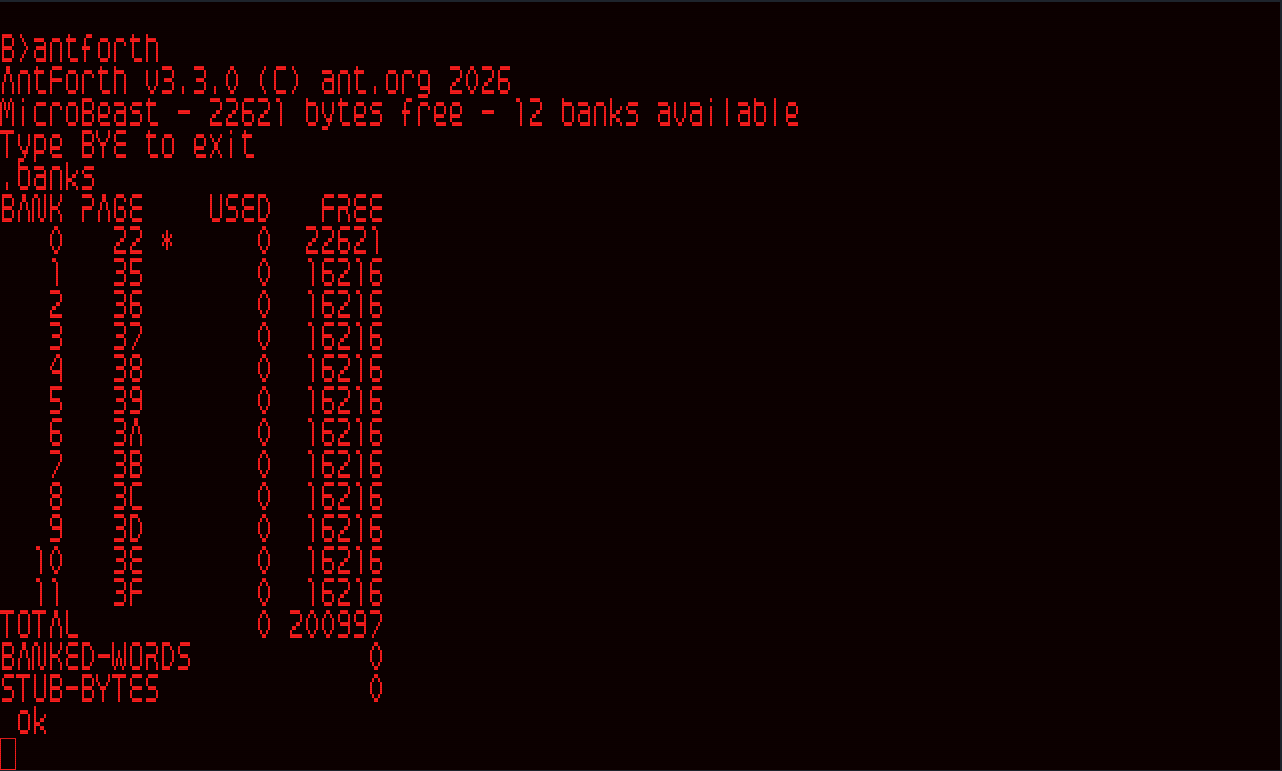
Phase 4 taught our Z80 Forth to address half a megabyte through one banked window. That was the big, rocky climb. Epic 23 is the opposite: a single, focused epic that sands the edges of the wordset, closes a handful of ANS conformance gaps, and adds the small ergonomic words you reach for every day.
It ships as antforth v3.1.0 — the first minor release since v3.0, and the close of Phase 5.
What landed
Five feature stories:
- Named values (
VALUE / TO). You can now define a mutable named cell and assign to it by name — 42 VALUE LIVES, then LIVES . prints 42, and 99 TO LIVES updates it. This is the standard ergonomic middle ground between a CONSTANT (immutable) and a VARIABLE (you fetch and store through an address). It was the biggest single piece of the epic, because making it bank-aware meant a full resolve/map/unmap trio so a VALUE defined in any bank reads and writes correctly. - Port I/O (
IN / OUT). Direct Z80 port reads and writes, surfaced as Forth words for talking to hardware. - Honest environment queries (
UD. and ENVIRONMENT? rows). UD. prints an unsigned double. More interestingly, the new ENVIRONMENT? rows tell the truth: queries for wordsets antforth only partially implements answer false ("recognised but incomplete") rather than a flattering true. - An assembler operand-order fix. The Z80 assembler's immediate-operand path was corrected to the Zilog destination-source convention. Byte-neutral, but a real correctness fix.
- A banking guard the review caught (
23.6). More on this below.
A bug that never shipped
The most valuable thing Epic 23 produced is a bug that didn't reach silicon.
antforth's code review runs adversarially, in a fresh context. The standing rule is that a review which finds nothing is suspect, not reassuring. On the named-values and port-words stories, that review surfaced a silent correctness defect: a banked colon definition whose body grew past $C000 would have its runtime read through the wrong bank window. No crash, just quietly wrong results, the worst kind of bug.
That finding became its own story (23.6): a window-top overflow guard. Its own review then caught a second one: a 16-bit wraparound in ALLOT. Both would have shipped silently. Neither did.
Why this matters. The temptation in a "polish" epic is to relax the adversary. The work feels low-risk, the reviews feel like ceremony. Epic 23 is the counter-argument: the one story that mattered most for correctness existed only because the review refused to relax.
The byte ledger
Every byte is measured from a clean rebuild and accepted at its story's close. The epic grew the kernel by +563 bytes, and free RAM measured on real hardware (24,954 B) independently corroborates that ledger.
| Story |
What |
Δ bytes |
| 23.1 |
Assembler operand-order fix (Zilog dst-src) |
0 |
| 23.2 |
VALUE / TO (bank-aware) |
+317 |
| 23.3 |
IN / OUT port words |
+19 |
| 23.4 |
UD. + honest ENVIRONMENT? rows |
+112 |
| 23.6 |
Banked window-top overflow guard |
+115 |
|
antforth v3.1.0 total |
+563 |
The original estimate was ~300 B, so the epic ran about 1.9× over, squarely inside the ~2.4× "cross-bank plumbing always undershoots" multiplier we learned to budget for in Phase 4. The single biggest overrun (VALUE/TO) is exactly where the bank-aware machinery lives. The pattern keeps confirming itself.
Where this leaves antforth
v3.1.0 is a tidier, more conformant Forth than v3.0.7: named mutable values, hardware port access, and environment queries that don't oversell themselves. All of it bank-aware, all of it verified on real hardware.
The big platform shifts (a cooperative multitasker, counting semaphores, full ANS locals) are recorded for a future phase. Epic 23 did quieter, equally necessary work: making the foundation strong before further building on top of it.